
the awakening Body
An embodied ecology for understanding human experience
the back story
Throughout the past twenty years, one thing has become increasingly apparent to me through my studies and my own inner work. Many disciplines have contributed profound insights into what it means to be human. Some have explored the body, others the psyche, others the imaginal world of dreams and symbol. Yet these conversations have often remained separate, each illuminating one part of the whole. I found myself increasingly drawn to the spaces where they overlapped. Each seemed to illuminate something precious about what it means to be human and so I became curious about what might emerge when they were allowed to speak to one another.
As a yoga teacher, I've spent countless hours observing my students' bodies: the way their breath moved, the places they unconsciously held tension, the subtle ways they armoured themselves, and their capacity - or difficulty - to truly surrender in savasana or yoga nidra. Their bodies told stories of the experiences they had lived through, expressed through the nervous system, connective tissue, and habitual patterns of movement, posture, and protection.
What also became apparent was how many people approached yoga as though it were solely a practice of moving the body, rarely considering that every movement and every breath was also shaping the mind. The body and psyche were never separate; they were in constant dialogue.
During my counselling training, however, the body only occasionally entered the therapeutic space and was largely absent from the conversation. I was surprised that, even with growing interest in Polyvagal Theory and wider research into nervous system regulation, these perspectives received relatively little attention. There was little discussion of how to read a client's body language, notice the catch in their breath, or recognise the ways the body speaks when words cannot. It felt as though an essential part of the person had been left outside the room.
As for the imaginal - the domain of dreams, symbols, mythology, and the living language of the unconscious - it often occupies the margins of contemporary therapeutic discourse, dismissed as unscientific or lacking therapeutic value. Yet it is here that some of the deepest truths about ourselves quietly reveal themselves. Carl Jung devoted much of his life's work to demonstrating that dreams, symbols, and imagination are not meaningless by-products of the mind, but profound expressions of the psyche itself. Through them, aspects of ourselves that have been forgotten, defended against, or never fully lived can begin to find expression. The imaginal is not an escape from reality; it is another way of encountering it. In a culture that often privileges only what can be measured, the imaginal offers another kind of knowing: one that has long deserved a place in the therapeutic conversation.
Rather than replacing these traditions, The Awakening Body seeks to honour them, drawing together the wisdom each offers into a more integrated understanding of what it means to be human.
the foundation
It became impossible for me to continue thinking about human beings in fragments. We don’t simply have a body, a mind, or an unconscious, we are an inseparable expression of all three. Every emotion has a bodily expression. Every bodily pattern influences our psychological experience. Every dream, symbol, and image arises within a living, feeling body. Healing, therefore, cannot belong to one domain alone. This understanding became the foundation of The Awakening Body.
The Awakening Body is a framework for understanding ourselves as whole human beings. Rather than treating the body, psyche, and imaginal as separate aspects of experience, it recognises them as three living dimensions that are continually informing one another.
The Body reveals what has been lived, protected, held, and forgotten.
The Psyche gives meaning, relationship, and awareness to experience.
The Imaginal offers symbols, dreams, myth, and imagination that guides transformation.
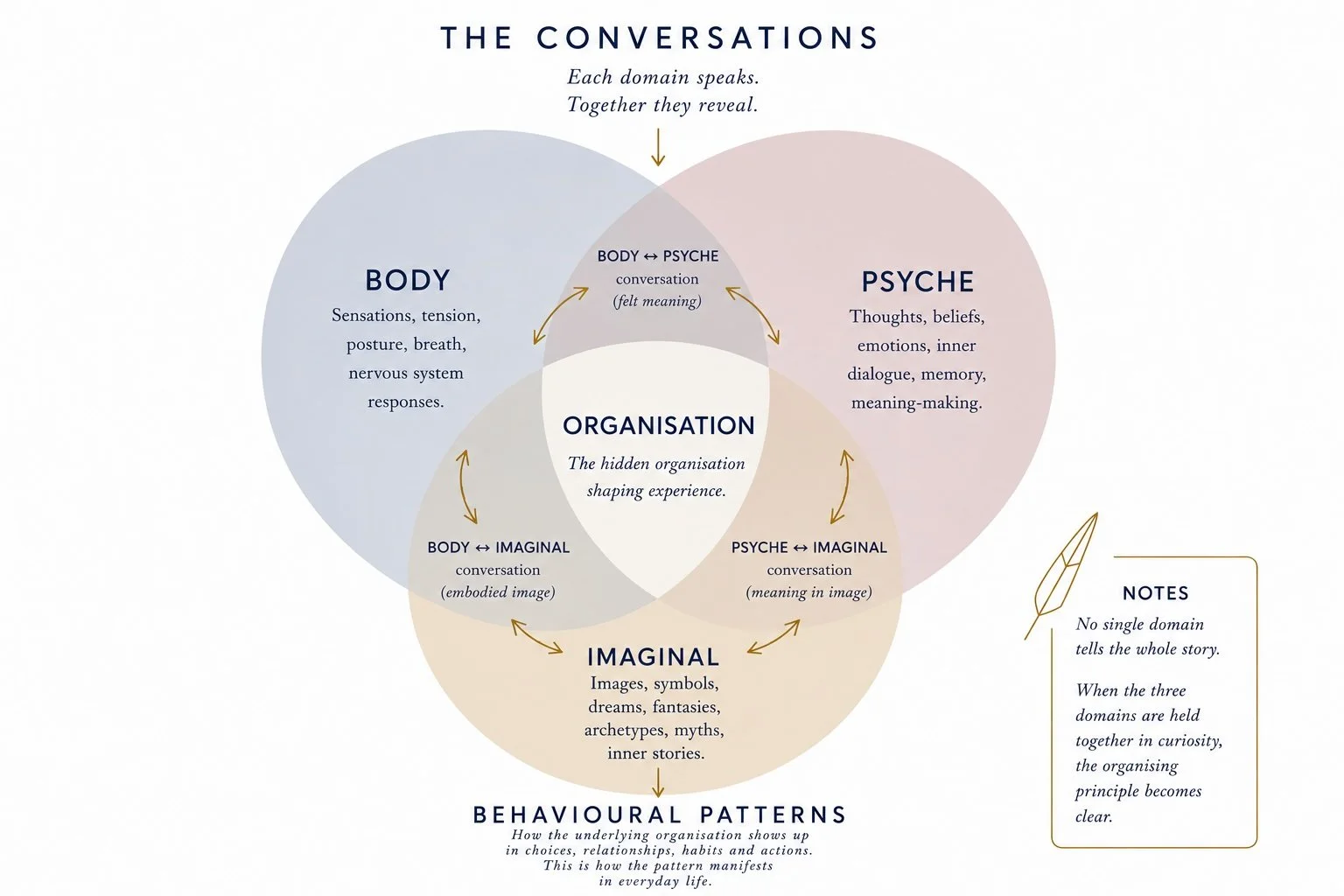
Rather than viewing these domains in isolation I invite them into conversation with one another, for its within these conversations that hidden patterns begin to reveal themselves. If we only listen to one of these domains, our understanding remains partial, but when all three are welcomed into the conversation, a deeper organisation begins to reveal itself. We can see their interactions in the diagram below:
Let’s explore each one in a little more detail…
-
The Body
The body is not simply the vessel that carries our psychological life; it participates in it.
The body offers a direct way into our lived experience. It remembers what words often cannot. Every breath, posture, sensation, and movement carries information about how we have adapted to our lives and the world around us.
The language of the body is sensation, movement, physiology, and breath. Our nervous system responses, patterns of tension, and the ways we habitually hold or protect ourselves are not random; they are meaningful expressions of how we have learned to survive, relate, and belong.
Within The Awakening Body, the body is never viewed as something to fix, but as something to listen to. By bringing gentle awareness to our embodied patterns, new possibilities begin to emerge.
This might include working with movement practices such as yoga, conscious breathing, nervous system regulation, therapeutic touch where appropriate, and deep rest. These practices are not simply techniques for relaxation; they create opportunities for the body to discover new ways of organising itself and, in doing so, open the possibility for psychological change.
The language of the body is sensation.
-
The Psyche
The psyche is not merely the mind; it is the inner life seeking relationship, meaning, and wholeness.
The psyche is the living landscape of our inner world. It is through the psyche that we think, feel, remember, imagine, relate, and make meaning from our experiences. Our beliefs, emotional patterns, relationships, values, and sense of identity all emerge from its continual dialogue with both the body and the world around us.
The psyche is not static. It is constantly adapting, organising, protecting, and seeking coherence. Sometimes this happens consciously, but much of its activity takes place beyond our immediate awareness. The ways we interpret our experiences, the stories we tell ourselves, and the patterns that repeat throughout our lives often reveal the psyche's ongoing attempt to make sense of what has been lived.
Within The Awakening Body, the psyche is approached with curiosity rather than judgement. Through reflection, therapeutic dialogue, active imagination, and the exploration of emotions, relationships, memories, and recurring patterns, we begin to understand not only what we experience, but how we have come to experience the world in the way that we do.
As awareness grows, the psyche is no longer confined to repeating old adaptations. It becomes increasingly capable of creating new meaning, deeper relationship, and greater freedom.
The language of the psyche is meaning.
-
The Imaginal
The imaginal is not simply imagination; it is the symbolic language through which the deeper psyche reveals itself.
The imaginal is the realm of dreams, symbols, myths, archetypes, and imagination. It is one of the primary ways in which the psyche speaks, offering images that often reveal what ordinary thinking cannot.
Unlike analytical thought, which seeks explanation, the imaginal invites relationship. A dream is not a puzzle to be solved, nor is a symbol simply something to decode. Instead, images ask to be experienced, reflected upon, and entered into with curiosity. Over time, they begin to disclose meanings that are uniquely personal while also connecting us to universal human patterns.
Within The Awakening Body, the imaginal is approached as a living dimension of experience. Through dreams, symbolism, mythology, active imagination, creative practices, and the spontaneous images that arise in everyday life, we encounter aspects of ourselves that have yet to find expression. These images often illuminate the organising patterns shaping our lives long before we can fully articulate them in words.
The imaginal reminds us that transformation is not only something we think about or physically embody; it is also something we imagine into being. By learning to recognise and relate to this symbolic language, we open ourselves to a deeper dialogue with the unconscious and, ultimately, with ourselves.
The language of the imaginal is image.
Organisation
At the centre of the framework sits organisation. It is here that body, psyche, and imaginal converge, revealing the underlying pattern from which our experience emerges. Everything we experience is organised. The ways we move, think, feel, dream, relate, and protect ourselves are rarely random. They are expressions of an underlying organisation that has developed over the course of our lives. Sometimes that organisation supports us beautifully, sometimes it becomes rigid, and sometimes it continues protecting us long after the danger has passed.
Within The Awakening Body, the question is not, "What is wrong with you?" its "What organisation has shaped this experience?"
When body, psyche, and imaginal are held together in conversation, the organising principle gradually becomes visible. Once it can be seen, new possibilities naturally begin to emerge.
THE POP Method
The Awakening Body framework offers a way of understanding ourselves; the POP Method is how we begin exploring that understanding in practice.
Every person's journey is unique. Some sessions begin with the body: a sensation, posture, or nervous system response. Others begin with a recurring dream, an emotional pattern, a relationship, or a symbol that refuses to leave us alone. There is no predetermined sequence. Instead, we take a phenomenological approach, following what is most alive in the moment. As body, psyche, and imaginal enter into conversation with one another, the underlying organisation gradually reveals itself. From there, the POP Method unfolds through three movements.
P: Pattern. What is emerging into awareness?
We begin by noticing what is becoming visible. Rather than asking, "What is wrong?" we become curious about what is repeating, presenting itself, or asking to be seen.
O: Organisation. What underlying organisation is revealing itself?
As body, psyche, and imaginal are brought into conversation, the deeper organisation shaping the experience gradually becomes visible. We begin to understand not only the pattern itself, but the underlying organisation from which it has arisen.
P: Participation. How might I participate differently?
Insight is not the end of the process. As we participate differently in our lives, new experiences naturally emerge. These, in turn, reveal new patterns, inviting us once again into deeper understanding. And then, the cycle begins again.
When body, psyche, and imaginal are finally invited into conversation with one another, we do not become someone new. We simply remember the wholeness that has been present all along.